Age gap rule
The Age Gap Rule: A Mathematician's Take on Who You Can Date
Or: how I spent an afternoon turning relationship norms into exponential functions
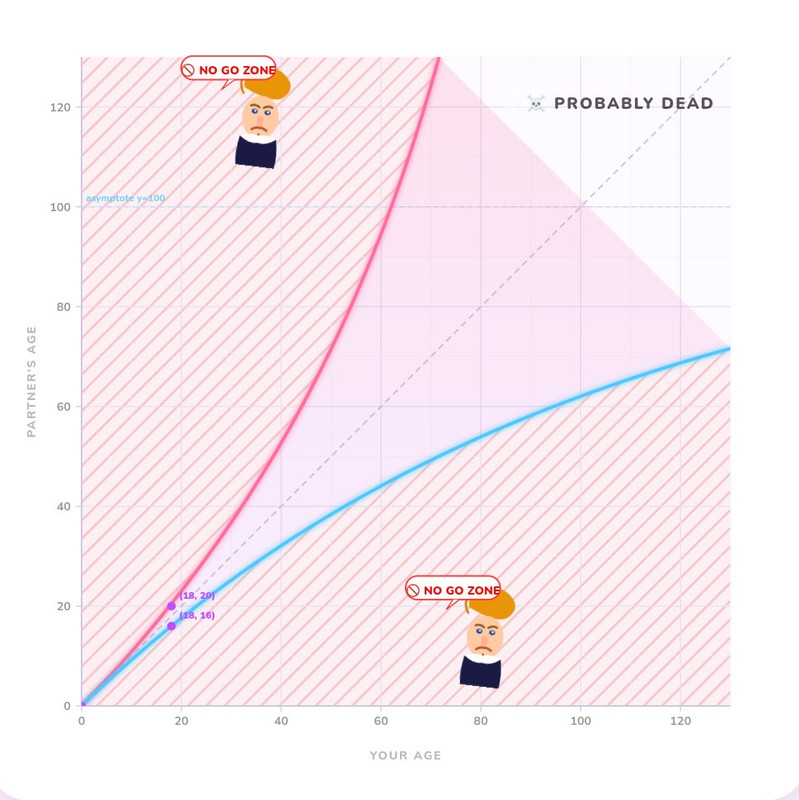
Everyone knows the old "half your age plus seven" rule. It's been around forever, quoted at dinner tables, cited in arguments, and used to justify some questionable life choices. But here's the thing nobody talks about: it only gives you a minimum. What about the maximum? And what happens when humanity eventually figures out how to live to 500?
I couldn't let these questions go unanswered. So I built the math.
The Problem with the Classic Rule
"Half your age plus seven" is elegant in its simplicity. At 30, your minimum is 22. At 40, it's 27. Clean, intuitive, widely accepted.
But it's incomplete. If the minimum age for a 30-year-old is 22, then logically, the maximum age for a 22-year-old should be 30. That's what symmetry means: if A can date B, then B can date A. The classic rule completely ignores this — and any attempt to bolt on a maximum formula by hand tends to break that symmetry.
I tried a few approaches. Linear formulas, parabolas, power functions. Some were mathematically tidy but socially absurd. Some felt right at 30 but exploded into chaos at 65. None of them held up across the full range. Then I found something that worked.
The Formula
The key insight was to use an exponential function for the lower bound — one that starts at zero, rises quickly for young ages, and then flattens into an asymptote. The upper bound is simply its mathematical inverse, which guarantees perfect symmetry by construction.
Lower bound (minimum partner age):
min(x) = 100 · (1 − e^(−λx))
Upper bound (maximum partner age):
max(x) = −ln(1 − x/100) / λ
Where λ = −ln(0.84) / 18 ≈ 0.00984, calibrated so that at age 18, the acceptable range is exactly [16, 20].
The symmetry check is built right in: min(max(x)) = x, always. If your max is 34, then 34's min is you.
What It Actually Looks Like
A few values to make it concrete:
| Your age | Min partner | Max partner | Window |
|---|---|---|---|
| 18 | 16 | 20 | 4 years |
| 25 | 21.7 | 31.2 | 9.5 years |
| 35 | 29.2 | 48.5 | 19.3 years |
| 50 | 39.3 | 68.5 | 29.2 years |
| 65 | 47.2 | 108 | 60.8 years |
The window expands naturally as you age — which matches the intuition that a 10-year gap means something very different at 25 than it does at 55. The lower bound flattens toward 100 as an asymptote, reflecting the biological reality that your partner can't be younger than a certain floor once you're old enough. And the upper bound? It grows without limit.
Which brings us to the fun part.
The Extreme Cases (aka The Probably Dead Zone)
One of the more unexpected features of this formula is what happens near the asymptote. As your age approaches 100, the lower bound closes in on 100 — and the upper bound approaches infinity. In other words, the formula politely suggests that at a certain age, your eligible partner pool is essentially "anyone still alive."
Push past 100, and the upper bound formula mathematically breaks down: you're trying to take the log of a non-positive number. The chart handles this gracefully by marking that region PROBABLY DEAD in the top-right corner.
At 200 years old, your minimum partner is around 86 and your maximum is somewhere north of 400. At 500, you're looking at a range of roughly [270, 980]. The math holds. Whether human relationships at that scale would still resemble anything we recognize today is a separate question entirely.
The Interactive Tools
Because a formula without a visualization is just homework, I built two tools to go with it.
The chart plots both curves on a shared axis, with the acceptable zone highlighted and the NO GO ZONEs marked with hatching — and, for reasons that made sense at the time, two animated SVG caricatures of Donald Trump shaking their heads in disapproval. They seemed appropriate guardians of the forbidden zones.
The calculator lets you enter any age and instantly see your min, max, window width, and a real-time symmetry verification. It also tells you if you're in "probably dead" territory.
📈 Interactive Chart 🧮 Age Gap CalculatorWhy This Matters (Or Doesn't)
No formula is going to tell you who to date. Compatibility is messy, context-dependent, and frankly none of mathematics' business. But there's something satisfying about taking a folk rule that everyone quotes and nobody has properly formalized, and building it into something internally consistent, symmetric, and future-proof.
The Calendrier Idéal doesn't tell you how to think. It tells you when to stop. This formula doesn't tell you who to love. It tells you where the edges are. Both are, in their own way, architecture.
Also, I wanted to see what happened at 500 years old.
Now you know.
This project is part of Babelbiche Bazaar — a blog about taking questions too seriously and seeing what happens. Start with a question, build the math, make it interactive, write the article. Repeat.
Mathematics Relationships Data Humour Interactive
Try the interactive chart and the age gap calculator · Built with SVG, JavaScript, and an unreasonable amount of time
Comments
Post a Comment