Reformatting Time
Reformatting Time
A proposal for a universal, secular, and intentional calendar — the Ideal Calendar
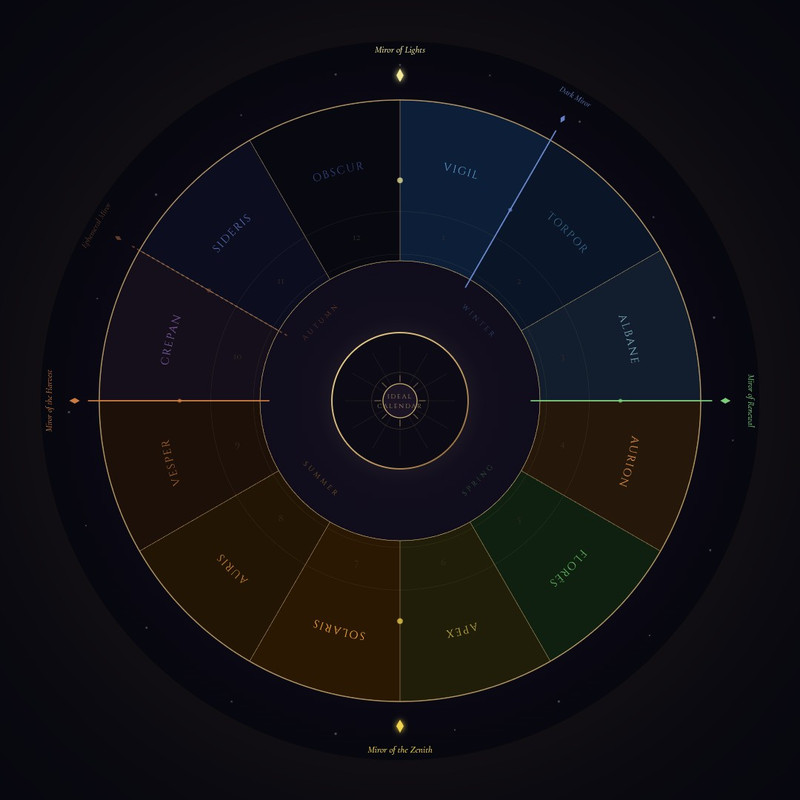
What if the problem wasn't how we fill our time, but how we divide it? That's the question behind the Ideal Calendar — a complete redesign of the calendar, grounded in light, real astronomy, and a philosophy of the week.
Every great civilizational shift has wanted its own calendar. The French Revolution with its republican calendar. The USSR with its five-day week designed to break the Christian Sunday. The Islamic Republic of Iran counting from the Hegira. A calendar is never neutral. It encodes who decides when we work, when we rest, what we celebrate, whom we honor.
The Ideal Calendar does the same thing, but in reverse: it de-ideologizes. It celebrates no one — no Caesar, no Augustus, no saints, no emperors. It celebrates phenomena. Light. The earth. Time passing.
The Structure: Simple, Symmetrical, Solid
The core principle is almost brutally clear: 12 months of 30 days, made up of 5 weeks of 6 days. Every month is identical. Every week is identical. The 15th of any month will always fall on the same day of the week — forever.
That's when you realize just how absurd our current calendar is. How many times have you had to check what day the 3rd of next month falls on? With the Ideal Calendar, never. Day 1 is always Recreo. Day 8 is always Prepday. No exceptions. No surprises.
The 365 days of the year break down as follows: 360 calendar days + 5 special days called Mirors, inserted at precise moments throughout the year. Leap years add a sixth Miror — the Ephemeral Miror.
The Months: A Metaphor of Light
The calendar begins at the winter solstice — the darkest moment of the year, the zero point of returning light. The entire year is experienced as a single day: midnight at the winter solstice, sunrise at the spring equinox, noon at the summer solstice, sunset at the autumn equinox.
| # | Name | Meaning | Season |
|---|---|---|---|
| 1 | Vigil | The night that keeps watch | Winter |
| 2 | Torpor | The numbness, the destitution | Winter |
| 3 | Albane | The pale dawn | Winter |
| 4 | Aurion | The aurora breaks | Spring |
| 5 | Florès | The vegetal explosion | Spring |
| 6 | Apex | The climb toward the zenith | Spring |
| 7 | Solar | The sun in full power | Summer |
| 8 | Auris | The golden afternoon | Summer |
| 9 | Vesper | The evening drawing near | Summer |
| 10 | Crepan | The ambiguous light | Autumn |
| 11 | Sider | The starlit night | Autumn |
| 12 | Obscur | The darkness before the return | Autumn |
These names are both descriptive and universal. Torpor doesn't require speaking French — everyone understands what the numbness of February feels like. Florès evokes blossoming across Romance languages and beyond. Light is the only phenomenon truly shared by all of humanity simultaneously.
The Intentional Week
This may be the Ideal Calendar's most radical proposal. The six days of the week are not recycled planet names — they describe what each day is meant to be.
Each week tells a complete cycle: recharging, preparation, action, completion, review, play. It's almost Stoic. It presupposes that a well-lived week has a shape — and that this shape can repeat indefinitely.
Direcens institutionalizes reflexivity. In most work cultures, stopping to assess what you've done is seen as unproductive. Here it's structural, collective, legitimate. As for Ludo — play as the sixth day, not as a reward but as a normal component of the week — that's an anthropological statement. Play is not the opposite of work. It's part of it.
The Mirors: Days Outside of Time
Mirors are days that belong to no week, no month. They are thresholds. Institutionalized suspended time. They fall at the four great astronomical moments of the year, plus a fifth at the heart of winter.
Miror of Lights — Winter Solstice. New Year's Day. We celebrate the return of light with light — fires, lanterns, candles. A beautiful paradox.
Dark Miror — Mid-winter. The depth of darkness. The hardest moment of the year, named honestly.
Miror of Renewal — Spring Equinox. The sunrise of the year.
Miror of the Zenith — Summer Solstice. Noon of the year. The suspended moment before the descent.
Miror of the Harvest — Autumn Equinox. The human gesture answering the astronomical one.
And every four years, a sixth Miror appears — the Ephemeral Miror. A day that exists only rarely, dedicated to the four-year review. What has changed? What have we accomplished? Where are we going? This exists in no known calendar. It is an institutional invitation to temporal depth — a response to presentism, that growing inability of modern societies to think on a long timescale.
What It Would Actually Change
Reformatting time imperceptibly reformats the way we relate to the world. A few concrete consequences of such a calendar:
A worldwide secular synchronicity. For the first time in history, all of humanity would live the same seasons at the same moment — not because a pope or a Caesar decided so, but because the sun is at the same position for everyone. On December 21st, we stop everywhere. Not for a god, not for a nation. For the light.
A reconnection to natural time. If you live in Torpor, you know you are at the heart of winter. The month names become a permanent inner weather forecast. Obscur doesn't let you forget where you are in the year. In a civilization that increasingly decouples lived time from natural time — tomatoes in January, air-conditioned offices, artificial light — this is a gentle but constant reminder.
A week that means something. No longer suffering Monday because it's Monday, but being in Prepday, and therefore preparing. The shape of the week as a soft prescription, an invisible architecture of daily life.
The Ideal Calendar doesn't tell you how to think. It tells you when to stop. In a civilization of permanent acceleration, that may be the most radical proposal of all.
Of course, resistance would be massive. Religious calendars don't disappear by decree — shared time creates community as much as it expresses it. The real sociological question is: can a universal calendar be proposed without being imperialist? The Ideal Calendar's answer is to try through subtraction rather than imposition — removing the names of gods and kings rather than imposing new ones.
Explore the Ideal Calendar
Three interactive tools accompany this article:
🌀 The Wheel of the Year 📅 The Annual Calendar ⇄ The Date ConverterEnter any Gregorian date to see its equivalent in the Ideal Calendar — with the lunar phase of the day.
The Ideal Calendar is a work in progress. The names are provisional, the structure may evolve — particularly for the southern hemisphere and equatorial regions, where the light metaphor takes on an entirely different meaning. That is the nature of a universal calendar: it cannot be finished by one person, in one hemisphere, in one language. It must be built collectively. This text is an invitation to participate.
Universalism Calendar Secularism Time Philosophy

Comments
Post a Comment